Choosing Dark Red Pe Masterbatch in 2026 requires more than matching a color chip. The red pellet must disperse evenly, remain stable during processing, and suit the final product’s use. A slightly bluish shade can appear brown after molding. Small differences matter.
Plastics Europe reported global plastics production at approximately 414 million tonnes in 2023. Its Plastics—The Fast Facts 2024 report also highlighted continuing pressure to improve circularity and resource efficiency. These trends affect masterbatch selection. Recycled polyethylene may contain moisture, contaminants, or variable melt flow. Therefore, a formulation that performs well in virgin resin may behave differently in recycled feedstock. Practical trials remain essential.
Industry forecasts from Smithers and MarketsandMarkets indicate continued demand for color masterbatch across packaging, construction, agriculture, and consumer products. However, market estimates differ by definition and region. Treat forecasts as direction, not proof. A reliable evaluation should check pigment concentration, carrier compatibility, let-down ratio, heat resistance, lightfastness, and migration performance. Color should be measured with recognized methods, such as CIE L*a*b* values under controlled conditions. Processing trials should record barrel temperature, screw speed, residence time, and film thickness. Ask suppliers for technical data, safety documentation, and batch-to-batch consistency records. For food-contact or other regulated applications, confirm compliance with the specific destination-market requirements. No supplier is perfect. Unexpected shade drift can still occur. The strongest decision combines laboratory data, production experience, and a documented approval sample.
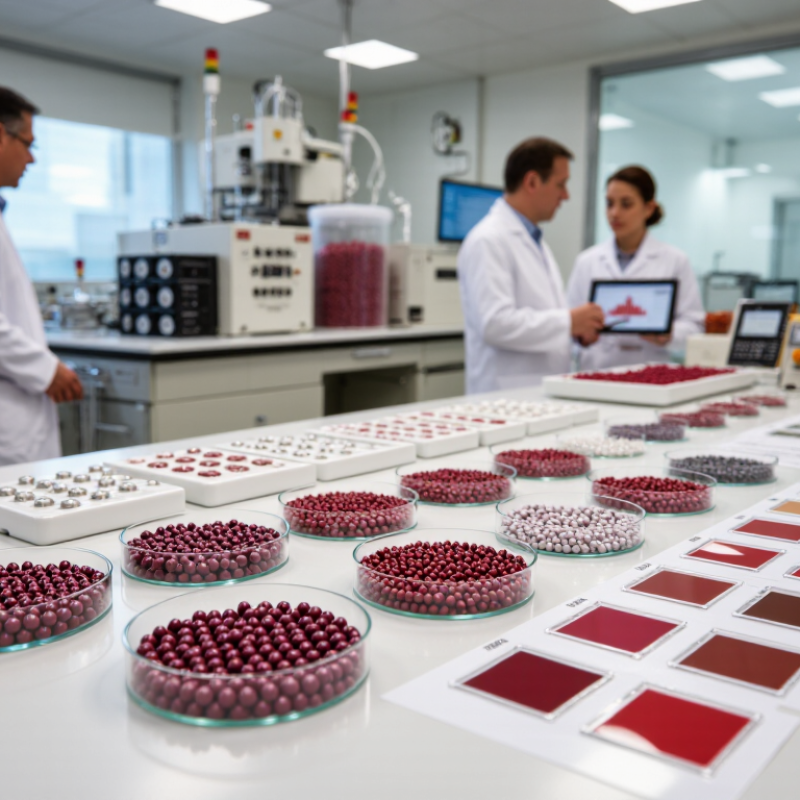
In 2026, choosing dark red PE masterbatch starts with understanding how it works. It is a concentrated color system designed for polyethylene processing. It usually contains red pigments, a PE carrier, and dispersing additives. During heating, the carrier melts with the base resin. Processing shear then separates pigment clusters into fine particles. This creates a more uniform color in film, containers, pipes, or molded parts. The pigment alone does not control the result. Carrier compatibility matters greatly.
A practical trial begins with a small let-down test. The technician measures resin weight, masterbatch dosage, temperature, and mixing time. Dark red can shift toward purple, brown, or orange after small dosage changes. Surface gloss can also change how people judge the shade. Small errors matter. I recommend checking both a fresh sample and a cooled sample under consistent lighting. The first visual match should remain provisional.
Selection should also consider heat stability, light exposure, dispersion quality, and the intended PE grade. Technical data should state recommended dosage, processing limits, and batch consistency. A reliable supplier can provide laboratory data and a retained reference sample for comparison. I have found that attractive pellets can still perform poorly in production. Pigment loading may be uneven, or the carrier may disperse slowly. Trial results deserve more trust than appearance alone.
| Data Dimension | Typical Data or Range | What It Means When Choosing Dark Red PE Masterbatch |
|---|---|---|
| Product Definition | A concentrated blend of color pigments dispersed in a polyethylene-based carrier resin | The masterbatch is mixed into natural or colored polyethylene during processing. The carrier should be compatible with the final resin, such as LDPE, LLDPE, HDPE, or selected polyolefin blends. |
| Color Description | Dark red, usually ranging from deep crimson to burgundy depending on pigment selection and dosage | Request a physical color plaque, molded sample, or film sample because “dark red” is not a universal color specification. Compare samples under consistent daylight or an agreed light source. |
| Recommended Let-Down Ratio | Approximately 1%–5% for many general-purpose applications | The correct dosage depends on pigment strength, product thickness, opacity requirements, and the base resin. A lower dosage may be suitable for translucent products, while higher dosage can improve coverage in opaque products. |
| Pigment Concentration | Common commercial grades may contain approximately 20%–60% pigment, depending on the pigment system and application | Higher pigment concentration can reduce the required addition rate, but dispersion, viscosity, and cost must also be evaluated. The exact concentration should be confirmed in the technical data sheet. |
| Carrier Resin | LDPE, LLDPE, HDPE, or another compatible polyolefin carrier | Choose a carrier with similar processing behavior to the host resin. A mismatch may cause poor dispersion, streaks, surface defects, or unstable feeding. |
| Melt Flow Rate | Often selected within a range suitable for the process and host resin; the specified value must be checked against the supplier’s test method | For film, injection molding, blow molding, and extrusion, the masterbatch should flow and disperse adequately without excessively changing the melt behavior of the finished compound. |
| Heat Stability | Many PE color applications are processed around 160–230°C, but pigment stability varies | Select a pigment system that remains stable at the actual barrel, die, and residence-time conditions. Excessive heat can cause shade change, fading, or pigment degradation. |
| Lightfastness | Rated on a standardized scale such as Blue Wool or ISO 105-B02; performance depends on pigment chemistry and exposure | For outdoor products, agricultural film, containers, or long-term displays, prioritize a grade with verified lightfastness data rather than relying only on the initial color appearance. |
| Weather Resistance | Application-specific; outdoor performance requires UV and weathering evaluation | Dark red products exposed to sunlight may need a UV-stabilized formulation. Ask for accelerated weathering results using a documented method and exposure duration. |
| Moisture Content | Normally controlled at a low level, often below 0.1% for well-dried PE-based pellets | Low moisture helps reduce bubbles, silver streaks, and processing instability, especially in film, extrusion, and injection molding. Confirm the test method and packaging condition. |
| Dispersion Quality | Should be uniform, with no visible pigment specks, streaks, or agglomerates in the finished product | Good dispersion is essential for consistent shade and surface quality. Evaluate a production-representative sample rather than judging only the appearance of the pellets. |
| Opacity and Hiding Power | Depends on pigment type, concentration, film or wall thickness, and the color of the base resin | For opaque dark red parts, compare contrast-ratio or drawdown results where available. A transparent or natural base may require a different dosage from a gray or recycled base. |
| Migration and Bleeding | Should be evaluated for the intended application; risk increases with unsuitable pigments, additives, or contact conditions | For packaging, flexible film, or products touching other plastics, check pigment migration, bleeding, and rub resistance. Food-contact suitability must be verified separately for the target market. |
| Processing Compatibility | Suitable grades are available for film extrusion, blow molding, injection molding, sheet extrusion, and rotational molding | Select a grade tested in the same or a similar process. Processing shear, cooling rate, wall thickness, and residence time can all affect the final dark red shade. |
| Recycled Resin Compatibility | Color consistency can vary because recycled PE may contain mixed polymers, residual colors, additives, or contaminants | When using recycled content, run a dosage trial across actual resin batches. A stronger or more opaque color system may be needed to mask variation in the substrate. |
| Quality-Control Checks | Color difference, moisture, melt flow, ash or pigment content, dispersion, and pellet appearance | Use agreed test conditions and color tolerances. Instrumental color data such as L*, a*, and b* values can support visual approval, but the final standard should reflect the end product. |
| Packaging and Storage | Sealed moisture-resistant bags stored in a cool, dry place away from direct sunlight | Proper storage helps maintain pellet flow, cleanliness, and consistent dosing. Follow the product’s shelf-life and handling instructions, particularly after opening the package. |
| Key Selection Priority | Color match + compatibility + dispersion + durability + regulatory suitability | Do not select solely by price or pellet appearance. Approve the masterbatch through a controlled trial using the real resin, processing conditions, target dosage, and final-product requirements. |
Match the carrier with the resin type. Film grades usually suit LDPE or LLDPE. Injection molding may require HDPE compatibility. Check melt flow rate before trials. A mismatch can cause streaks, gels, or uneven red shades.
Yes. Film extrusion often uses lower shear. Injection molding uses stronger shear and faster cooling. Keep pigment stability within the actual barrel temperature and residence time. Small temperature changes can shift the shade. Test the real process.
Compare samples with an approved reference plaque. Measure CIE Lab values and color difference. Do not rely only on eyesight. A small indoor difference may appear obvious beside a production batch. Lighting matters.
Use a thin-film microscope test. Look for specks, streaks, and pigment clusters. Check filtration pressure and surface appearance during extrusion. Test the intended dosage, not only a high laboratory concentration. One test is not enough.
Request pigment type, carrier resin, pigment loading, and recommended dosage. Ask for melt flow data and results from several production lots. Request batch-to-batch color difference records. A written replacement policy helps. Paperwork can still miss process problems.
Compare the delivered cost per colored kilogram. Include dosage, filtration waste, output loss, and testing expenses. A cheaper concentrate may require more material. Run the same resin, temperature, screw speed, and dosage for comparison. Price alone misleads.
Request a current safety data sheet and restricted-substance screening. Check pigment composition, heavy-metal results, volatile content, and recycled-content compatibility. Packaging requires migration testing for the actual food type, temperature, and contact time. Avoid generic safety claims.
Accelerated weathering tests can compare materials under controlled conditions. They cannot perfectly predict several years outdoors. Test plaques after heat, ultraviolet exposure, and storage. Inspect them under daylight and indoor lighting. My confidence should remain limited.
Choosing the right Dark Red Pe Masterbatch in 2026 requires more than selecting an attractive color. Buyers should understand how the pigment concentrate works within polyethylene, then evaluate pigment strength, heat stability, light resistance, moisture content, carrier compatibility, and recommended dosage. The masterbatch must match the selected PE resin and processing method, including film extrusion, injection molding, blow molding, or other applications, to ensure consistent coloring without affecting production efficiency or finished-product performance.
Color quality should be checked through laboratory samples and production trials, with attention to dispersion, shade consistency, surface appearance, and resistance to migration or fading. Material safety documentation and compliance information are also essential for the intended application. When comparing suppliers, consider not only price per kilogram but also pigment concentration, technical support, batch consistency, testing capability, delivery reliability, and long-term performance. A structured evaluation helps manufacturers choose a cost-effective Dark Red Pe Masterbatch that delivers stable color and dependable processing results.