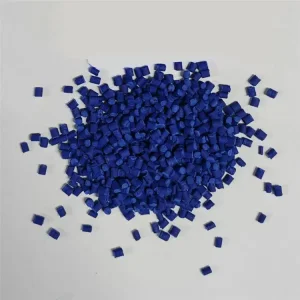
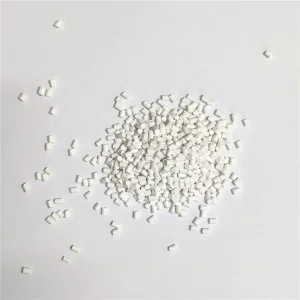
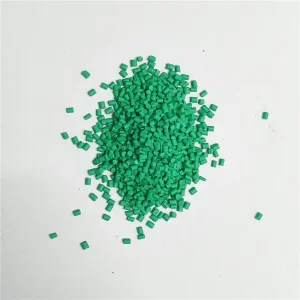
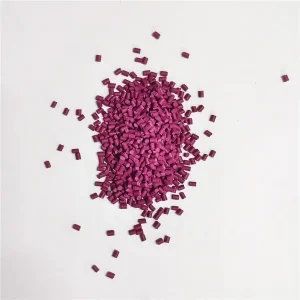
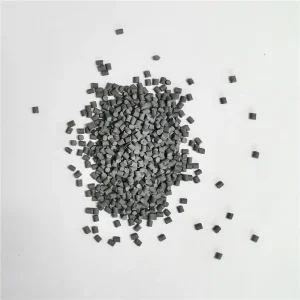
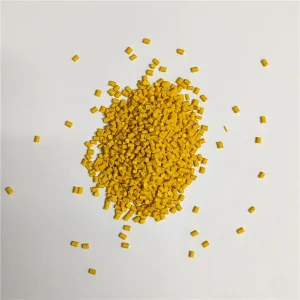
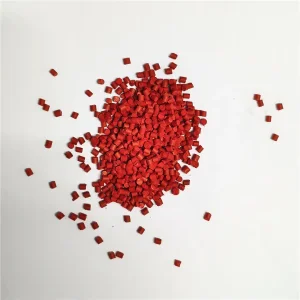
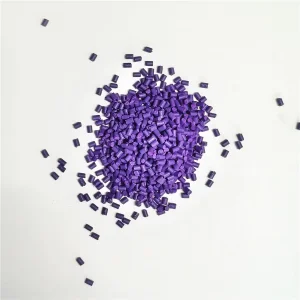
Engineered with high pigment loading, superior heat resistance up to 260°C, and exceptional non-migration stability for blown film, extrusion, and injection molding.
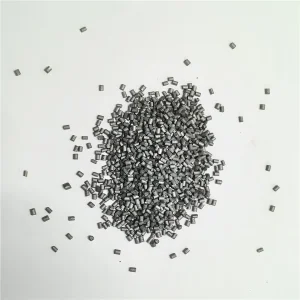
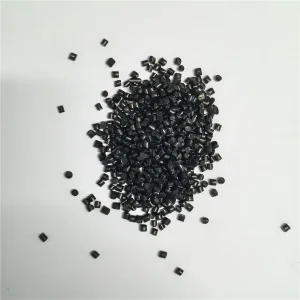
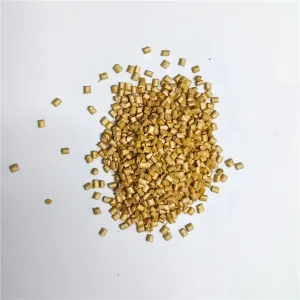
Understanding how cost-efficiency, high pigment loading, and molecular non-migration co-exist in modern polyolefin compounding.
In plastic converting—especially low-density polyethylene (LDPE), linear low-density polyethylene (LLDPE), and high-density polyethylene (HDPE)—pigment migration manifests as blooming, plate-out, or solvent bleeding. Bleeding occurs when organic pigment molecules possess slight solubility within the polyolefin matrix at elevated processing temperatures ($200^\circ\text{C}-260^\circ\text{C}$). As the plastic cools, the dissolved pigment molecules recrystallize and diffuse toward the surface, causing color transfer to contact surfaces, food products, or adjacent film layers.
Anti-migration masterbatch formulation requires precise molecular encapsulation. By matching the solubility parameter of high-molecular-weight organic or inorganic pigments with specifically modified polyethylene wax carriers and hyper-dispersants, manufacturers lock pigment particles into stable crystalline micro-domains, suppressing thermal diffusion kinetics.
In B2B plastics procurement, the term "cheap anti-migration PE masterbatch" does not denote substandard raw materials; rather, it reflects optimized manufacturing economics achieved by leading Chinese factories like Changzhou Jiazhou Plastic Products Co., Ltd. (operating a 6,000m² facility with 16+ years of expertise).
Cost parity is achieved through three macro-economic levers:
How evolving global regulations and circular economy initiatives are reshaping masterbatch purchasing criteria.
The global surge in 3-layer, 5-layer, and 9-layer blown film processing for food packaging, agricultural mulch, and courier bags requires zero-migration colorants. Pigment bleed between adjacent film layers ruins barrier aesthetics and compromises heat-seal integrity. Anti-migration PE masterbatches are now formulated specifically to preserve interlayer adhesion and optical clarity.
International compliance standards—including FDA 21 CFR 178.3297, EU Regulation No 10/2011, and GB9685 in China—strictly govern specific migration limits (SML) for heavy metals and aromatic amines. Modern anti-migration formulations replace low-cost diarylide yellows or azo reds with high-performance organic pigments (such as ISO-indolinone and quinacridone) bound in non-migratory PE matrix systems.
As brand owners commit to 25%-50% Post-Consumer Recycled (PCR) polyolefin content, plastic masterbatch manufacturers must engineer anti-migration additives that counteract volatile contaminants, residual oils, and color instability inherently present in recycled resin streams.
Navigating Total Cost of Ownership (TCO), supplier evaluation, and batch consistency for international B2B buyers.
Procurement teams across 100+ countries face a persistent trade-off: procuring low-cost masterbatch often results in filter mesh clogging, color streaking, or severe surface migration during long-distance ocean freight storage. Conversely, tier-1 Western brands offer high performance at uncompetitive pricing.
By partnering directly with ISO-certified manufacturers in Changzhou, buyers bypass intermediary markups while securing custom color-matching, technical data sheets (TDS), safety data sheets (SDS), and guaranteed batch-to-batch color variance ($\Delta E < 0.5$).
High L/D ratio twin-screw compounding lines ensure sub-micron pigment dispersion without thermal degradation.
Every batch is evaluated via spectrophotometer, melt flow indexer (MFI testing), and pressure filter test (PFT) values.
Heavy-duty moisture-proof PE bags (25kg net) with UV-stabilized stretch wrapping prevent humidity absorption during transit.
Tailored anti-migration masterbatch grades optimized for high-speed automated plastic conversion machinery.
Target Products: Shopping bags, agricultural mulch film, stretch wrap, heavy-duty shipping sacks.
Technical Challenge: High blow-up ratios (BUR) stretch pigment particles, risking pinholes and color non-uniformity.
Jiazhou Solution: Ultra-fine dispersion eliminates agglomerates, maintaining bubble stability at high line speeds (>150m/min) while rendering zero color rub-off during printing or laminating.
Target Products: Bottle closures, crates, electrical enclosures, housewares.
Technical Challenge: High injection pressure causes shear-induced pigment migration and mold surface deposit (plate-out).
Jiazhou Solution: Thermally stable carrier matrix ensures clean mold release, crisp dimensional tolerance, and vibrant surface gloss without dye exudation.
Target Products: PE-RT heating pipes, HDPE agricultural irrigation tubes, corrugated conduit.
Technical Challenge: Extended outdoor exposure and chemical fluid contact cause pigment leaching and environmental stress cracking.
Jiazhou Solution: Synergistic addition of light stabilizers (HALS) and antioxidant additives ensures long-term outdoor weatherability (>10 years) without pigment extraction.
Providing end-to-end B2B technical consulting, fast sample prototyping, and global export compliance.
Our color laboratory utilizes advanced Datacolor spectrophotometers to match target Pantone, RAL, or customer-provided plastic plaques within 48 hours. By analyzing reflectance curves across the visible spectrum (400–700nm), our polymer engineers formulate anti-migration masterbatch recipes that achieve Metamerism index $< 0.8$ under D65, A, and F11 illuminants.
Free 1kg-5kg trial samples dispatched globally via DHL/FedEx for machine trial runs and LDR optimization.
To eliminate compliance risks for international buyers, Changzhou Jiazhou Plastic Products Co., Ltd. provides full documentation suites certified by third-party testing bodies (SGS, Intertek, TUV):
Innovations shaping the next generation of eco-friendly, non-migratory polyolefin additives.
Emerging research focuses on reactive colorants where pigment chromophores are covalently bonded directly to the polyethylene polymer backbone during polymerization. This eliminates physical diffusion pathways entirely, yielding absolute zero-migration even under extreme solvent contact.
Aligning with global carbon-neutrality targets, masterbatch carrier resins are transitioning from fossil-based LLDPE to sugarcane-derived bio-PE. These bio-based carriers maintain identical melt rheology and processing temperatures while reducing upstream scope 3 carbon emissions.
Factory production lines are integrating inline machine vision spectrophotometers coupled with AI neural networks. This technology automatically adjusts feeder rates in real time if color drift or dispersion anomalies are detected during twin-screw compounding.
Direct technical answers to common buyer queries regarding masterbatch application, pricing, and factory operations.
Pigment migration is caused by partial solubility of low-molecular-weight organic dyes/pigments within amorphous domains of polyolefins under thermal processing. Over time or upon solvent contact, these color molecules diffuse outward, creating surface blooming or staining adjacent surfaces. Anti-migration masterbatches solve this by utilizing high-molecular-weight, highly insoluble organic or inorganic pigments encapsulated within modified PE waxes and hyper-dispersants, physically locking color particles into stable crystalline lattices.
True cost-efficiency comes from high pigment loading (which lowers the required Let-Down Ratio to 1%-2%) combined with automated twin-screw manufacturing efficiency. Sourcing directly from Changzhou Jiazhou Plastic Products Co., Ltd. eliminates distributor markups while securing high dispersion quality. High dispersion means less masterbatch is needed to achieve high opacity and non-migration, reducing total cost per ton of finished plastic.
Our standard anti-migration color masterbatches are thermally stable up to 260°C (500°F) for continuous extrusion and injection molding. Special high-heat grades are engineered to withstand temperatures up to 280°C–300°C without color shade shifting, gas generation, or thermal degradation.
In multi-layer blown films (ABA, ABC, or 5-layer co-extrusion), standard masterbatch can migrate across film layers, causing delamination or discoloration of transparent outer layers. Jiazhou's anti-migration masterbatch maintains strict layer localization, keeping color pigments completely contained within designated skin or core layers.
We supply comprehensive compliance dossiers with every export shipment, including ISO 9001:2015 Quality System Certification, RoHS 3 test reports, REACH SVHC declarations, Food Contact Compliance (FDA / EU No 10/2011), and Heavy Metals (EN71-3) test certificates.
The standard recommended LDR ranges between 1% and 4%, depending on film thickness and desired opacity. For thin blown films (15–30 microns), an LDR of 2%–3% is typically optimal. For injection molding thick-walled components, 1%–2% LDR provides full coverage while minimizing additive costs.
Direct factory ordering for high-concentration PE color, filler, and special effect masterbatches.